Australia
Come Visit Down Under
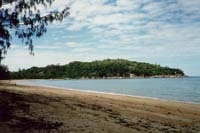  A secluded beach on Magnetic
Island located just off the Townsville coast in Queensland, Australia.
>>> A secluded beach on Magnetic
Island located just off the Townsville coast in Queensland, Australia.
>>>
I was met at the Magnetic Island dock by Ken,
the friendly proprietor of Centaur House. His small comfortable
hostel had a casual charm that reflected his easy going attitude
and lifestyle. The place lacked pretense and its laid back atmosphere
made you feel like you were staying at the summer home of an old
friend.
Of all the islands I visited in Australia, Magnetic was my favorite.
It had the distinctive character of an individual island community.
Even the terrain and topography was unique. Huge boulders and strange
rock formations defined the island's interior landscape. Much of
the island was a protected national park dotted with small private
bays and harbors that sheltered little villages and enclaves along
the shore.
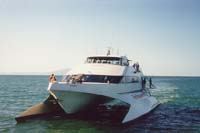 <<< This odd
"Klingon-styled" catamaran that carries sightseers from
the Queensland coast out to the Great Barrier Reef. <<< This odd
"Klingon-styled" catamaran that carries sightseers from
the Queensland coast out to the Great Barrier Reef.
I went on an excursion out to the Great Barrier
Reef on a vessel that resembled a Klingon warship. We boarded a
huge catamaran that looked like it had just dropped out of a Star
Trek episode and headed out to Kelso Reef, one of the many small
coral reefs that form the 1200 mile long Great Barrier. The giant
Australian aquatic park contains more than 600 islands and 900 different
species of fish.
A few hours beyond Magnetic Island the dark water fell away and
turned a clear blue green. We dropped anchored and I donned a snorkel,
mask, and fins. I swam a few dozen meters over to the reef outcropping
and snorkeled around in the coral.
The shallow coral reef resembled an underwater forest filled with
an amazing variety of sea life in an ever changing kaleidoscope
of colors. I swam amidst scores of brilliantly colored parrot fish,
odd slender trumpet fish, eerie blue starfish, and giant clams anchored
to the coral bottom. Under a w arm sun I spent hours snorkeling
the reef, diving down through the coral canyons. I was lost in the
natural rapture of a most incredible underwater hallucination.
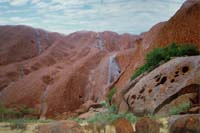 A rare rainy day at Uluru,
or Ayers Rock, in the desolate Australian Outback. Traces of waterfalls
can be seen on the sides of the massive desert rock which is sacred
to the Aboriginal people. >>> A rare rainy day at Uluru,
or Ayers Rock, in the desolate Australian Outback. Traces of waterfalls
can be seen on the sides of the massive desert rock which is sacred
to the Aboriginal people. >>>
The weather in the Australian Outback had turned
strange. The usually hot, dry, sun scorching climate had turned
uncommonly wet and cool. I could make out the rising shape of Ayers
Rock in the distance. A thick cloud cover obscured the upper third
of the massive rock, giving it the appearance of a flat plateau.
The sacred Aboriginal sight is called Uluru by the native people.
Under cloudy skies it looked nothing at all like the familiar image
of a glowing red rock contrasted against a bright blue desert sky.
The rain had dropped off to an occasional thick drizzle. Tourists
were al ready climbing the rock by the time we had arrived. The
steep lower section is outfitted with a long chain used as a handhold
assist for climbers. There is a small plaque near the rock base
that lists the names of people who have fallen or suffered heart
attacks while attempting the climb.
Aboriginals don't climb Uluru, although they allow tourists the
opportunity. They call them "white ants" and I laughed
when I saw the climbers. That is exactly what they looked like as
they scrambled up the massive mound of stone.
Clouds rolled and tumbled off the rock. It glistened and darkened
in the rain, taking on a dark mercurial presence. The mist and clouds
animated the face of the rock, giving it an ever changing eeriness.
Like a giant natural sculpture, Uluru changes color, texture, and
shape at every angle. It rises up majestically from the desert floor,
carved by wind, sand, and water. The rock is sacred to every Aboriginal
tribe on the Australian continent.
Before I left, the sporadic rain cascaded down the sides of Uluru
in narrow waterfalls, a rare occurrence in the dry arid Outback
desert. The weird weather brought even more magic and mystery to
a place that is strangely unreal and timeless even in the hot bright
light of day.
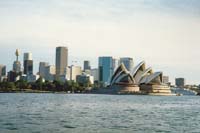 <<< The unmistakably
distinctive architecture of the Opera House in Sydney Harbour. Located
on the New South Wales coast, Australia's largest city rises in
the background. <<< The unmistakably
distinctive architecture of the Opera House in Sydney Harbour. Located
on the New South Wales coast, Australia's largest city rises in
the background.
Sydney is a modern metropolis of 3 million people
that bustles with the busy pulse of urban energy and life. It's
Australia's showcase, the largest and most cosmopolitan city on
an island continent of 18 million people.
I took the city bus down to Circular Quay for a relaxed boat tour
of Sydney Harbour. The ferry meandered past the Opera House on a
beautiful sunny May day. We passed the remainder of the day cruising
up quiet inlets past historic old structures, modern harbour houses,
and sprawling Sydneysider mansions.
The cruise returned us to the Quay where I enjoyed the dockside
carnival atmosphere of didgerydoo buskers and street entertainers.
I walked along the Quay to the Opera House for a closer look at
Sydney's distinctive architectural landmark.
That night I rode the subway from the Central Rail Station to Kings
Cross. The few narrow blocks that defined the Cross are lined with
rock and roll night clubs, strip joints, budget restaurants, and
tourist shops. Kings Cross is where Disneyland meets Hollywood Boulevard.
International backpackers seek accommodation at the Cross's numerous
budget hostels. Tourists wander the gaudy streets in search of entertainment,
excitement, and a glimpse of the tawdriness. Sad eyed junkies loiter
around the lighted fountain at the far end of the street smoking
cigarettes and panhandling spare change. The Cross glitters like
a cheap bright jewel in the misty night rain.
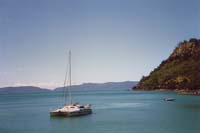 A chartered catamaran
lies anchored in the azure waters of the Whitsunday Islands off
the eastern Australia coast. >>> A chartered catamaran
lies anchored in the azure waters of the Whitsunday Islands off
the eastern Australia coast. >>>
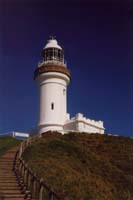 <<< The lighthouse in Byron Bay is located at the
easternmost point in Australian along the New South Wales coast. <<< The lighthouse in Byron Bay is located at the
easternmost point in Australian along the New South Wales coast.
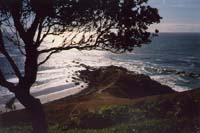 A view of the coastal point that juts out into the Tasman
Sea just beyond the Byron Bay lighthouse. >>> A view of the coastal point that juts out into the Tasman
Sea just beyond the Byron Bay lighthouse. >>>
Byron Bay is a curious alternative enclave, new
age tourist village, and laid back beach haven, all jumbled into
one. Cape Byron was named by Captain James Cook in May, 1770 for
John Byron, the grandfather of poet Lord Byron.
Migrating whales off the coast regularly attract binocular-toting
whale watchers along its shore. Pods of dolphins also played in
the water along the nearby public beach as oblivious surfers stoically
waited for their next wave.
The prominent white lighthouse above the town dramatically marks
the rugged coastline. Located at the country's eastern-most point,
it's the most powerful lighthouse in Australia, radiating 3 million
candle power of light out to sea.
More about Australia - As a service to you,
if you click on the linked items below, a window will open to Amazon.com
for more information and the opportunity to purchase these and other
selections.
Books:
Lonely Planet Australia - a Travel Guide by Hugh Finlay
Paperback - 9th edition (September 1998)
The Songlines by Bruce Chatwin Paperback - Rep edition
(June 1988)
One For The Road : Hitchhiking Through the Australian Outback
by Tony Horwitz
The Fatal Shore : The Epic of Australia's Founding by Robert
Hughes (February 1988)
Films:
The Last Wave (1977) Starring: Richard Chamberlain, Director:
Peter Weir
Mad Max Starring: Mel Gibson, Director: George Miller
Road Warrior - The Road Warrior (1982) Starring: Mel Gibson,
Director: George Miller
Crocodile Dundee (1986) Starring: Paul Hogan, Linda Kozlowski,
Director: Peter Faiman
Ned Kelly Ned Kelly (1970) Starring: Mick Jagger, Director:
Tony Richardson
Bliss (1997) Starring: Craig Sheffer, Sheryl Lee, Director:
Lance Young
Walkabout (1971) Starring: Jenny Agutter, Director: Nicolas
Roeg
My Brilliant Career
Incident at Hanging Rock
The Chant of Jimmie Blacksmith
Music:
Midnight Oil - "Redneck Wonderland" Audio CD
(November 3, 1998)
INXS - "Greatest Hits" Audio CD (November 1,
1994)
Crowded House - "Crowded House" Audio CD (October
11, 1988)
Paul Kelly "Words & Music" (Rock) Audio CD
(May 19, 1998)
T R A V
E L M E N U
M A I N M E N U
Text and Photography by Paul Picus.
Copyright © 1996-2008 Paul Picus
Copyright © 1996-2008 Gar Benedick,
All Rights Reserved.
comments
|
