The Islands of Fiji
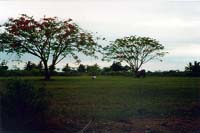 
A young boy in charge of the family cow takes
a rest in an open field near Sawini Beach on the island of Viti
Levu.>>>
I went out alone for a short walk before nightfall
along Sawini Beach. The evening was quiet and the shore deserted.
I watched a small boy in a nearby field minding the family cow.
The child calmly walked along playing alone, quietly amusing himself.
After a time, he moved the cow to another grazing spot coaxing the
animal forward with a slender stick that was half again taller than
the boy. I watched the languid child and his bovine charge until
the Fijian sun slipped into tropical darkness.
That evening the neighboring farmers set fire to the sugar cane
fields a few hundred meters away from where I was staying. The night
sky glowed with roaring flames. The scene took on an eerie beauty,
as I watched the fires rising in the darkness, a raging inferno
under a silver full moon.
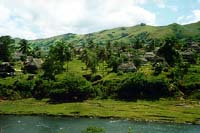
<<< This Fijian village is constructed
of traditional bures, thatched-roof dwellings that are still used
throughout the islands.
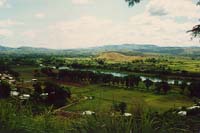
A view of a fertile farmland valley near the
town of Sigatoka, an
important agricultural area on the island of Viti Levu.>>>
A Fijian tribal elder had arranged a van and
driver to take a group of us to the undeveloped interior of Viti
Levu. The grey haired elder was a tall, friendly, self-effacing
man in his early sixties.
We set off in the morning, twelve of us crammed into the back of
a
ong-wheelbased Toyota van, and headed into the hills above Sigatoka.
The paved highway ended a few kilometers outside of town. The main
road that intersected the island deteriorated into a pot holed ribbon
of dirt. Our bone-jarring ride continued through the highlands along
the steep, deeply rutted roads. We banged around inside shoulder
to shoulder, knee to knee, rolling and jostling back and forth like
a seesaw. It was a slow, hot, dusty adventure through the countryside.
The island interior was pristine, dotted with a few small settlements
and yurt-like Fijian huts of the traditional bure villages. We slowly
bounced along, occasionally stopping to take in panoramas of the
green valleys and surrounding countryside. I was amazed at the natural
beauty of the largely undeveloped interior highlands. The jagged
mountains looked like a smaller version of the American Southwest,
if you could imagine the desolate desert peaks and mesas incongruously
draped in lush tropical growth.
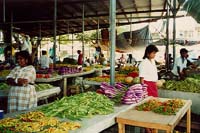
<<< Colorful produce and vendors at
the town market near the coast of Viti Levu, Fiji's largest island.
The crowded bus stopped adjacent to the outdoor
market in Sigatoka with the driver's radio still blasting at full
volume. The music during the hour and a half drive from Nadi was
a great mix of local World Beat/African influenced music, Jamaican
reggae, and contemporary rock and roll. I wandered through the central
market in Sigatoka around the stalls of the open air market, buying
fruit and vegetables from the Indian and Fijian vendors. It was
a busy little bazaar filled with a pleasant mix of exotic sights,
sounds, colors, and smells.
Stalls and tables were brimming with bright red tomatoes and peppers,
yellow squash, pungent onions, garlic, and baskets of spices. The
sweet smell of mangoes, papayas, bananas, and other colorful tropical
fruits wafted through the air of the busy market. Fijian vendors
sold souvenir trinkets, cassette tapes, clothing, and a bewildering
variety of strange goods resembling some secular cargo cult.
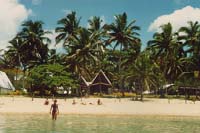
Swaying palm trees and blue skies frame the white
sand beach resort of Tubakula on Viti Levu's sunny south coast.>>>
At Tubakula narrow paths led past A-framed bungalows
with shaded porches that were sheltered under a canopy of coconut
palms. Each of the shared two-story bungalows accommodated six people
and featured a complete kitchen with all the amenities, a dining
area with table and chairs, comfortable rattan chairs to lounge
in, and a separate shower and toilet. There was a beautiful white
sand beach twenty meters from the front door and a large pool located
in the center of the complex. It was a vision of paradise for a
modest $6 U.S. a night.
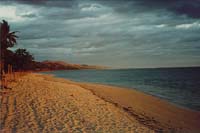
<<< Not a single soul to be seen along
this tranquil, deserted Fijian beach at twilight.

T R A V E L M E N U
M
A I N M E N U
Text and Photography by Paul Picus.
Copyright © 1996-2008 Paul Picus
Copyright © 1996-2008 Gar Benedick,
All Rights Reserved.
comments
|
